
 Loading...
“You count now. You didn’t even count before.”
In Flannery O’Connor’s short story, “The River”, a young lonely boy ends up standing before a country preacher. The country preacher has just baptized the lonely boy, Bevel, and now tells him, “You count now. You didn’t even count before.”
For many Christians, that is the definition of baptism. If you are baptized, you count. If not, you don’t count and somehow live outside the circle of God’s concern. The ones who count, the baptized, have made a pact with God. The pact tends to be rather limited in its understanding of covenant. You have gotten right with Jesus. To paraphrase Tom T. Hall, it’s a me and Jesus proposition.
I am here this morning to suggest another view of baptism. It is a view of baptism that has great implications for today’s theme of faith and justice. You might say it is a thicker understanding of baptism.
Such baptism is a baptism, not only into the life of God, but also into the life of community. It is both the community of the baptized and the community of humankind. So, in effect, when I am baptized, I come to more fully understand that everyone counts.
Rowan Williams, the former Archbishop of Canterbury, in his book Being Christian, takes up this understanding of baptism and says “baptism does not confer on us a status that marks us off from everybody else.” (p.5) Rather, Williams suggests that baptism places us squarely in the middle of the world’s hurts and needs and concerns. Baptism does not protect those who count from those who do not count. Rather, baptism makes us aware of the brokenness of our world and equips us with hearts and heads that, because of our baptisms, will seek to bear the burdens of others, simply because they are human and made in God’s image. Baptism awakens us to others.
Let me quote one extended passage from Williams to sum up the case I want to make for a communal understanding of the vocation that baptism places upon Christians. Archbishop Williams says, “So, the baptized life is a life that gives us the resource and strength to ask awkward but necessary questions of one another and of our world. It is a life that looks towards reconciliation, building bridges, repairing shattered relationships. It is a life that looks towards justice and liberty, the liberty to work together to make human life in society some kind of reflection of the wisdom and order and justice of God.”
I believe this conversation regarding faith and justice is essential for me because I have been baptized and I count and I believe you count, regardless of your belief or unbelief. I believe my Christian faith calls me to a we and Jesus life, not me and Jesus alone.
In Williams’ extended quote, he mentions the word justice. A quick Google search to define justice suggested “just behavior or treatment.” That definition of justice sounds appropriate and measured.
However, I am aware that we live in a time when some seek a kind of justice that is not measured. Redemption is not a value for that kind of justice. Instead of redemption, think Rambo. Punishment for the sake of punishment is how such justice is defined. That is a distorted view of justice, though it is a popular view for too many. Unfortunately, it is also sometimes touted as biblical.
“Forgiveness is the justice of God.” The Rev. Sam Wells, former Dean of Duke Chapel, in a sermon at Duke, once offered that definition of how God understands justice. Forgiveness and God’s mercy is what is extended to humanity as God seeks to reconcile and redeem human brokenness.
Just as baptism is not concerned only with the one being baptized but also includes concern for the community, so the forgiveness we receive in God’s life is not a private transaction. Because I have experienced forgiveness, I am called to forgive others. Because I have been shown mercy, I am to live in a merciful way with others.
In The Episcopal Church, whenever we baptize, along with other significant days in the Church year, we are invited to renew the Baptismal Covenant. This Covenant is grounded in the Apostles Creed. But along with affirming creedal belief, a series of questions are also asked of all witnessing the baptism. The questions include asking if those present will “seek and serve Christ in all persons, loving neighbor as yourself” and if they will “strive for justice and peace among all people, and respect the dignity of every human being?” Those questions receive a hearty response of, “I will, with God’s help.”
Now, I opened my remarks by referencing an outdoor baptism in the Deep South. If you have ever attended an outdoor baptism, you know it can be a messy affair. Along with water, there is mud. In contrast, most of the baptisms I have performed and witnessed in an Episcopal context are rather tidy and neat. All is proper and in good order.
Yet, I often wonder if the congregation truly grasps the radical implications of those questions and their affirmations? Those present have confessed a belief that the act of baptism connects us to everyone. They all count, both those present and those absent. They all count, both believer and unbeliever. They all count, regardless of guilt or innocence.
If the community of the baptized plans to live out the affirmation to respect the dignity of every human person, it will require them to seek true reconciliation in a fractured time, to advocate for respect for all in a season when disagreement becomes license to disregard others. To respect the dignity of all, in my mind, has much in common with the belief that equal protection under the law is a value for our land that must be affirmed and reaffirmed constantly, just as we renew baptismal vows.
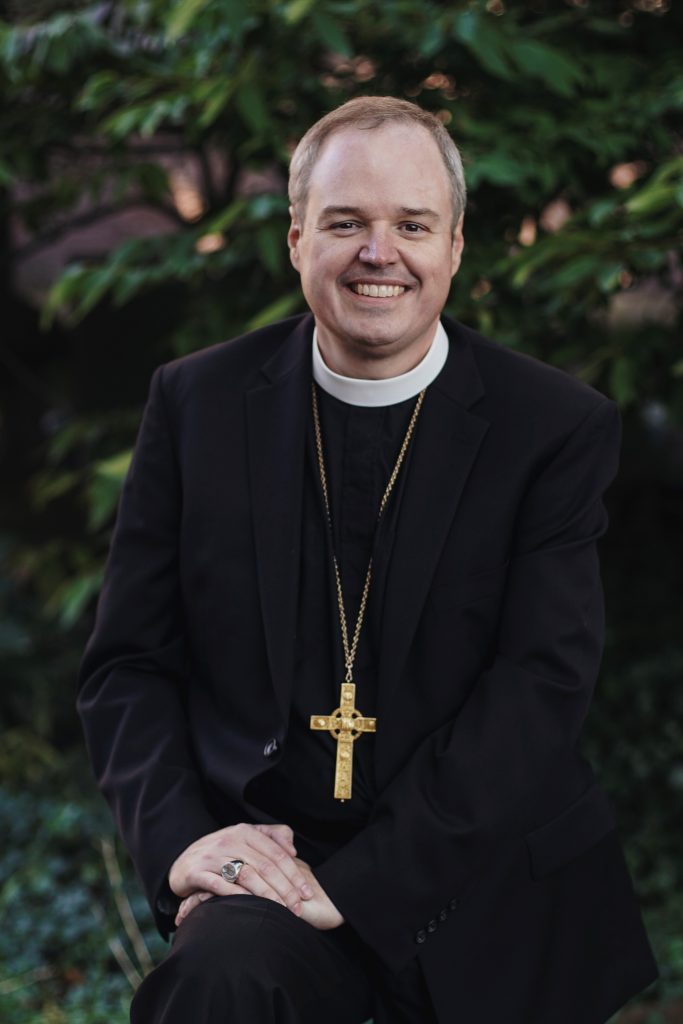
Finally, I also believe my life in the Resurrected Christ needs to be in conversation with justice concerns and the legal resources offered in a just society because of my own promises that I made as a bishop. Along with promises to pray and pastor and proclaim, along with promises to guard the faith, unity, and discipline of the Church, to share in ministry with other bishops, I also made a promise regarding mercy and compassion and help.
“Will you be merciful to all, show compassion to the poor and strangers, and defend those who have no helper?” For the sake of Jesus Christ, I promised I would.
Now, exactly how am I going to keep that promise? How am I going to defend all those in East Tennessee who have no helper? You may have noticed, but there are many people in East Tennessee and Middle Tennessee and West Tennessee who have no help. I can only keep a promise to help those without a helper if I seek others to help.
Who needs help in our communities? Those who are ill need help. In response to that need, parishes create pastoral care teams and organize meals for the ill and respite for caregivers. Recognizing that the physically ill aren’t simply the people we know, doctors and nurses and other medical professionals are organized to offer their professional help to others, both in domestic and international settings. The Church has recognized that those lay folk with medical expertise have vocational gifts to offer to those without help.
Just as parishes recognize people who live with illness need comfort and care, so people who are in need of access to legal assistance definitely deserve to be matters of pastoral concern for us. In preparing my remarks for today, I was reminded that while the Diocese of East Tennessee does not provide the bishop with a personal physician, I do have a Chancellor, an attorney at the ready to assist me with legal matters in the life of the Church. If the bishop is deserving of ready access to legal advice, surely those who do not have a helper need such access, too. Who will be advocates for such access? Why not those of us who believe that everyone should count?
I am also aware that my chancellor considers her work on behalf of the Diocese to be a form of ministry. Her call as an attorney is a vocation, a way by which she keeps her baptismal vows. The doctor who goes on a medical mission to Central America understands that. So, too, the attorney who assists those in need of legal assistance, of helping those who might believe they do not count in the eyes of the state, is also about the work of living out baptismal vows.
I want to share two examples of how I have seen ministry grow when the Church engages the legal community. One example is historical and one is just emerging for me.
For six years, I served as the rector of Church of the Good Shepherd in Lexington, Kentucky. Shortly after arriving at Good Shepherd, a member reached out to me and made us aware that The Rev. Becca Stevens was scheduled to be in Lexington to speak at a major conference in downtown Lexington. He knew Becca from Sewanee undergrad days and was willing to find out if she might also speak at Good Shepherd while she was in town.
If you do not know her, the Rev. Becca Stevens is an Episcopal priest in Nashville, Tennessee. For over 20 years, she has led Magdalene House and Thistle Farms. It is a ministry that works with women who have been victims of sex trafficking, who are often also dealing with addiction issues and are burdened by lengthy criminal records, too. Magdalene House offers them resurrection, a chance to engage in an intensive two year residency, where services related to job training, legal aid, recovery and education are wrapped around them in their healing.
Before she spoke at Good Shepherd, I already knew about Becca, but had not heard her in person. With little advance notice, we were able to attract around 75 people to hear Becca speak. She shared the evening with some of the women who were participants in Magdalene House. By the end of the evening, the whole room of those of us listening to Becca and the women being healed through her work were all deeply moved.
At this point, my wife turned to me and said, “We are going to do this work in Lexington.” She did not say we might pray about this or maybe we should write a check to support Becca’s work. No. Good Shepherd was going to take this kind of work on in Lexington.
My wife, Susan, along with several other women present that night all had the same response. We are going to do this here. So, they began. I can tell you that today there is a house in Lexington, called The Well which now is home to four women. Those women have come to The Well after prison, or through jail diversion efforts or after some time in a detox center.
After that first evening of hearing Becca speak in Lexington, the women of Good Shepherd who wanted to replicate her work had a great deal of homework to do. Much of that homework involved engaging with local law enforcement and the legal community. It involved numerous conversations with recovery efforts and women’s shelter workers. It required that all of us step out of our relatively safe and secure worlds and learn about the real horrors and hurdles in the lives of women saved by Magdalene House and The Well and similar efforts at combating sex trafficking.
I knew such work would require working with recovery efforts and social workers, with job training and ongoing mentoring and support. I did not realize the vital role that legal assistance could play in restoring the women of The Well to more abundant lives. Attorneys worked with them on expunging criminal records. Attorneys played crucial roles in advocating for their placement in jail diversion programs. Attorneys and courts working together understood that the women involved in prostitution were not the ones to target for punishment.
This new work for Good Shepherd ultimately grew to include many other houses of worship, including houses of other faiths. As individuals like my wife began to speak about the work, she met more and more attorneys ready and willing and eager to help offer legal aid in support of people who had been told throughout their lives that they did not count.
More recently, in my new work as the bishop of East Tennessee, I am discovering the critical role where faith concerns and legal resources need each other here and now in Tennessee
Two weeks ago, the Immigration and Customs Enforcement (ICE) raid of a meatpacking plant near Morristown culminated in the arrest of nearly 100 employees. While the plant came onto the radar of the IRS because of questionable activities related to the plant owners, the ICE raid targeted the employees.
I have been told it was the largest ICE raid in 10 years. While not all 100 employees will end up deported, all of those workers, along with their families and friends now live with uncertainty and fear.
The Episcopal priest in Morristown, Fr. Mark Holland, alerted me on Thursday evening, shortly after the raid. Fr. Mark has developed a friendship with Fr. Patrick, the local Roman Catholic priest in Morristown. The Roman Catholic Parish Center in Morristown was immediately turned into a community center of support for the meatpacking employees and their families and for the wider immigrant population in Morristown.
In response to the immediate fear, the Parish Center prepared to house individuals, to provide meals, medical assistance, and, most importantly, legal assistance. Along with attorneys from the Tennessee Immigrant and Refugee Rights Coalition, other area attorneys reached out to the Parish Center to offer free legal aid for those in need. I visited the Parish Center last Monday and received an important education into what our immigrant friends in East Tennessee are facing right now.
The need for legal assistance is not only related directly to deportation. Once someone is detained, even before deportation, legal concerns arise for the children of these workers. Many of those children are U.S. citizens who possibly are about to now live with a fractured and divided family. Those children need legal assistance related to powers of attorney and protection of them.
Remember the words of the baptismal covenant. Will you respect the dignity of every living person? Remember the expectation we have for ourselves as a country. Do we believe in equal protection under the law? If so, if I believe that my baptism requires me to respect human dignity for everyone and if as a citizen of this land I believe that everyone is deserving of equal protection under the law, how do I help make that tangible and real so that my beliefs and values are renewed each day?
Because of my baptism, I believe everyone counts. However, in my brief tenure as a bishop in East Tennessee, I have not seen the immigrant worker and it has been easy for me to believe immigrant concerns do not need to be a priority in my episcopal ministry.
The ICE raid in Morristown two weeks ago has caused me to see people I had not seen before. I promised to help those who have no help. If that simply means helping Episcopalians, then while there are definitely Episcopalians in need, it’s a manageable number in East Tennessee.
If, however, everyone counts, then anyone in need of help in East Tennessee is the concern of every Episcopalian and of this bishop. That number is too great to help on our own. We need advocates, legal advocates.
I also speak to you today in a season when many Episcopalians are concerned about the state of the Church. Do we have a future? Will we pass our Anglican faith on to the next generation? Will we be in the baptizing business 20 years from now?
We also are living in a crisis time for our nation. We are a people who believe in liberty and justice for all. We continue to wrestle with how broad the definition of all is. Getting clarity about that definition is not helped when political leaders seem through their reckless rhetoric to define all as not quite all. Through such rhetoric all becomes some and then some becomes only us. We count. You do not.
So, we need each other, faith and justice. Those in the Church who desire for their religious commitments to mean something need to know of those legal advocates ready to help people in need, people we say must count.
And those who believe in liberty and justice for all, who have responded to a vocation call to defend that belief, need many allies to support them in their work.
This time is also situated in the middle of the Easter season, when the Church proclaims life after death, Resurrection after ruin. We are now moving towards Pentecost, when the Spirit came to equip and enliven the faithful for the long haul work.
When Jesus told his followers about the Spirit to come and how Jesus would remain with them through the Spirit always, he called the Spirit the Advocate. We would not be alone, we would not be abandoned. He would send the Advocate.
We believe the Christ did send an Advocate. We believe the story of God is a story where everyone counts, especially those on the margin who believe the lie that they do not count.
In order to make sure that not counting is truly a falsehood, those of us who can must be their advocates and support and encourage and champion the legal advocates in our country who, through their work, offer here and now help.
This is the season for renewing baptismal vows and making those vows tangible and real in the land of the free.
This is the season for renewing our country’s great commitments and ensuring liberty and justice for all are not simply words always out of reach for those who live in fear in the home of the brave.