
 Loading...
“I have two memories. The first is when I learned to draw a smiley face. The second was when I saw what my grandfather did to my little sister – she was three. … I don’t know what age I was when the torture started on us, and we were good kids – it was just for my dad’s amusement. … My younger sister was told by my father she needed to get birth control. My mother had no expression.”
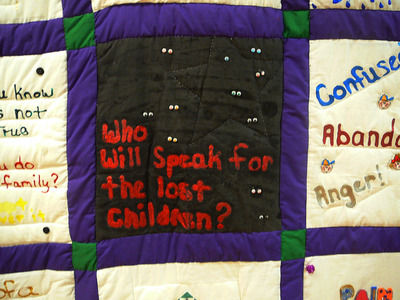
These words are from a victim of child abuse in a video titled “My Childhood Story,” soon to be available on Children’s Center of the Cumberlands web site.
The narrator of the video said, “A year or two ago a former school teacher reached out to me; I was shocked that she knew.” No one had ever said a thing to the children while they were in school, but the teacher told the narrator that there had been signs. “How different it would have been if someone would have saved us,” she said.
 “It still haunts me,” the narrator, now an adult, says, “but I sought help through the Children’s Advocacy Center and through the help I received I can now help others.”
“If you think something is wrong, do something,” she said. “All it takes is one person to make a call; one person to save a whole family.”
Children’s Center of the Cumberlands does something about child abuse.
Executive Director Kellie Mays said the center was established in 1998 and in 2009 moved into its current expanded building. It is a bright, cheery place that feels safe and loving the moment you walk through the doors. When a child comes in they are given a quilt right away to comfort them and to hold with them for the rest of the journey through a difficult process.
“We have many services, but our primary goal is to serve the child victim,” Mays said. “When people hear about child abuse and make a referral for the Child Advocacy Center, the Department of Children’s Services (DCS) goes to investigate, and the first place they take the child is here.”
In the Child Advocacy Center model, the principle desire is to minimize the trauma to the children, so instead of going to different places and talking with many people and doctors, everything is handled at the CAC.
One of the primary purposes of the CAC is the forensic interview. A child tells her or his story at the CAC while a detective and a Child Protective Services worker listen in as a team. There are no hidden cameras; the child is aware that they are also listening. The child also sees a doctor in the building and is referred to a counselor to help them.
It is an extremely difficult and stressful situation for the children. Mays said, “A lot of times in the forensic interview, the person they’re disclosing on is in the waiting room.”
If the child’s mother is also a victim of abuse, an advocate talks with her.
The abuse cases that the center handles may be sexual, physical or neglect. The District Attorney is seeing recurring child abuse in the court system – several family members coming through the cycle of abuse.
There is a lot of neglect because of drugs. “We have a severe drug problem in Scot County,” Mays said. “There is meth, but mostly prescription drug abuse is what we see in this area. When a parent is taken to jail for selling drugs we take care of those children,” she said.
The center’s counselors are kept up-to-date on training, and Mays stressed the importance of current materials so the presentations by counselors are not undermined. “It’s important they have new materials – if the kids see videos from the 80s, they know that the way people are dressed and their hair is not ‘normal,’ for today” Mays said.
The CAC gets busier at the beginning of the school year. One staff person goes into the school system (pre-K through high school), for two visits to each school throughout Scot County and Oneida during the school year, talking about safe touches, drugs, abstinence. For many children, this is the first time the child hears that what is happening to them is not normal.
Mays told pilgrims about an exciting new service the center will be providing. “Many times, the Department of Children’s Services calls us in the middle of the night. Sometimes it takes a day to find placement for a child. Right now, children sleep at the DCS office on a blowup mattress. We’re renovating a space in our building to look like a living room,” she said. “We’re the first CAC in Tennessee to have something like this. It will accommodate eight. We’ll also have a bedroom so we can decontaminate children if they come from a meth home.”
The CAC receives funds from grants, VOCA (Victims of Crime Act) Fund, some foundations and generous donors, “but we want the lights on and snacks on hand when children come in hungry – we want to keep the phones on, so we go out fundraising … and a child coming in here doesn’t have clothes or anything so we use some of our funds for that too. We had to raise $44,000 this year,” Mays said.
 As for repeat offenders, Mays said, “After parents meet requirements for drug rehab, they come home and we do see some re-victimization, but for physical and sexual abuse, it’s amazing how far we’ve come.”
“We’ve had an impact in the county ever since we started,” said Mays. “This is more than a program for us; it’s more like a ministry.”