
 Loading...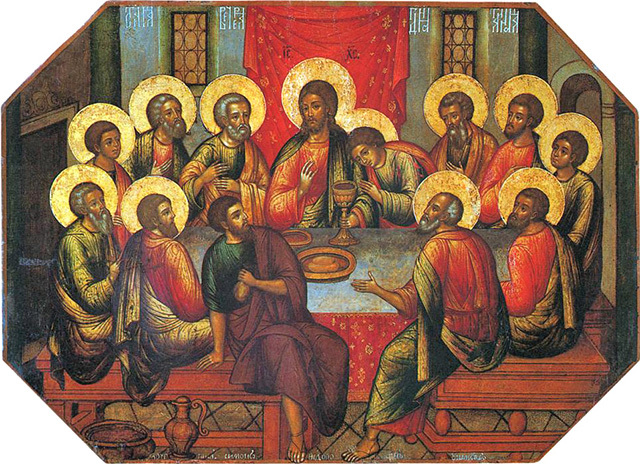
We have just heard an account of the last meal of a man before he is to be executed. Jesus, having one meal left, chose to share the meal with friends.
There continues, to this day, to be a tradition of allowing the condemned a last meal, a special meal, before the state takes their life from them. Often, the request from the death row inmate can be quite extensive.
Some last meals include cheeseburger, milk shake, French fries, along with fried chicken and corn and mashed potatoes. Others request steak and eggs, with biscuits and gravy and coffee and juice. Pizza is frequently added as a side dish. If only one meal is left to you, then why not eat everything in sight?
Along with those condemned to die by the state, I have met cancer patients who always included ice cream in every meal, not knowing how many were left. When my own father was dying of cancer, to help him maintain his weight, we always tried to add a chocolate Dove bar every day. The last meal I shared with him was at a Pizza Hut off of an exit on Interstate 55. We ordered a large pepperoni pizza. He barely finished one slice, if you were grading on a curve. “Let us eat and drink, for tomorrow we die.”
Several years ago, the state of Arkansas executed a man named Ricky Ray Rector. His last meal included pecan pie, which he asked to eat later. Mr. Rector had significant frontal lobe damage from a suicide attempt and did not understand that there would not be another meal. They did not try to explain that to him, and so set the pie aside, for later.
Last April, the state of Arkansas executed Ledell Lee. He had been convicted of killing his neighbor in 1993. Instead of asking for a caloric dense last meal, he chose to receive communion. He took the bread and the cup; the meal which will feed us forever.
I don’t know what you are thinking, but I know what I am thinking. But Jesus was innocent. Those prisoners, those death row inmates eating cheeseburgers and curly fries did something wrong. Jesus was innocent. He was framed and set up. They killed the wrong man.
But in the eyes of Rome, in the eyes of Herod, in the eyes of the Temple leaders, Jesus deserved a place on their death row. They even made him make his own arrangements for his very last meal.
There are accounts I have read of contemporary death row prisoners who did not choose a last meal for themselves, but instead asked that the other inmates on death row receive a special meal on their behalf. Typically, such a request is granted. So, they in a sense, share a meal with their friends.
In this evening’s Gospel, we hear that Jesus understood what time it was. It was the time of his last meal. It was also the time of the Passover meal. So, the Passover meal became the last meal. Jesus took an old tradition and he made something new of it.
That was Jesus’ way with so many things. “You have heard it said, but I say…” is often how Jesus taught and preached. He took the tradition, he took the stories of the faith and he gave them a new meaning.
The Passover meal tells of a time when God saved God’s people. So, when the meal is being shared, the people remember that God is the God that had saved them, brought them from slavery into freedom, from Egypt into Promised Land. The lamb is slain and the people share in that meal of innocence and memory.
Jesus knows this Passover meal is also the last meal before he is to be executed. He knows that he is innocent. And he knows that he is willing to accept a verdict of guilty. Without saying anything out loud to his disciples, Jesus knows how well he has loved them, in spite of themselves. He knows that he will continue to love them to the end. He knows that at the end, each one will be a betrayer, unable to love him perfectly in return. Still, he has one meal left and he wants to share it with his friends, his imperfect friends.
At this last meal, Jesus tells them a new thing about the meal now. You may think we are sharing Passover, Jesus tells them, but now we are also sharing my body, my blood. This bread and this cup, this last meal, is also the beginning of all the meals to come.
Forevermore, after this night, when you eat again, when you drink again, you are not eating and drinking for tomorrow you will die. You are eating and drinking my death now, for tomorrow I will live again. Jesus, as Jesus tends to do, flips the script, subverts the story, does not play by the rules of the State or the Empire or the Temple.
Tonight, we are sharing a last meal with a man who is about to die, to be executed. We believe he did nothing wrong. Yet, we also believe he turned the world upside down and for that reason, he is guilty, if you don’t want the world to be turned upside down.
Typically, an invitation to table fellowship, to partake in the body and blood of Jesus is a joyous time. It is a chance to find bread in the wilderness, to eat the meal that truly satisfies us and renews us.
“You do not know now what I am doing, but later you will understand.” As Jesus washes the feet of his followers and as he shares a last meal with them, he does so without them fully understanding what time it is. For Jesus, this is the time to love his friends to the end. This is the time to say the end is coming. After this meal, an execution awaits.
When we speak of baptism, we think of new beginnings, of new life, of water and Spirit and flame and oil. But tonight’s last meal reminds us that we are also baptized into death. We are baptized into suffering. We are baptized, both guilty and innocent, into the life of a death row prisoner.
“You do not know now what I am doing, but later you will understand.” Throughout Jesus’ ministry, he acknowledges those times when our faith and understanding is uncertain, when doubt and confusion must come before a deeper belief and confession. How many preachers have I met in my life who can only speak with certainty, in cold hard facts, in rigid rationalism, dressed up as proper belief?
Tonight, we will share a meal and we will not fully understand what it means to be a friend of Jesus, as someone worthy to be invited to the last meal of a dying man. Only later, after this holy place has been stripped of its symbols and sacred trappings will we realize we shared a meal, sitting on the edge of a tomb.
Only later, will we realize we were eating with an innocent man. Only later, will we, the guilty, realize that his last meal becomes something new for us.
For us, the last meal becomes the first. We did not deserve it, but the condemned man wanted us to eat again and remember him.