
 Loading...
The designation, “Appalachia,” brings to mind images of coal-mining communities, hills, hollers, and remote areas where poverty hangs like a blanket of fog over the landscape. While this description fits several of the mountain counties in our diocese, it fits our inner cities and many of our small towns as well.
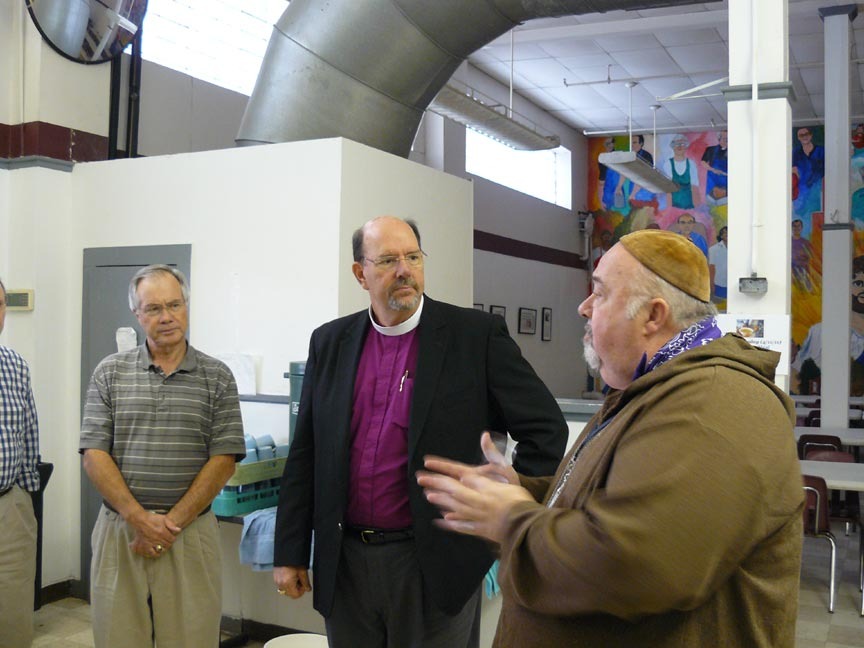
The diocesan Appalachian Ministries Resource Team (AMRT), which sponsors Appalachian Camp at Grace Point every summer, also seeks to showcase Appalachian ministries in the diocese. The team takes an annual fall “pilgrimage” into Appalachia, and this fall AMRT visited ministries in the southeast area of the diocese.
On the morning of September 7, eight East Tennessee Episcopalians led by Bishop George Young and including Canon Stephen Askew; Harry Chase, St. James, Knoxville; Lola Estes and Ruth Stephens, St. Stephen, Oak Ridge; Bill Fryar, St. John, Johnson City; John Hicks, Christ Church, Rugby; and Bob Wadley, Ascension, Knoxville, traveled in Ascension’s van down the interstate to Cleveland and Chattanooga.
Chattanooga Community Kitchen
Beginning in Chattanooga, the group first visited Chattanooga Community Kitchen, a ministry begun in 1982 by seven churches in downtown Chattanooga including two Episcopal churches, Christ Church and St. Paul. The ministry’s 5 case managers and hundreds of volunteers provide a wide variety of support services to Chattanooga’s homeless population. Chattanooga Community Kitchen is located in the part of the city which is also home to Christ Church, Chattanooga, and the University of Tennessee-Chattanooga.
Brother Ron Fender, BSG, Community Kitchen’s outreach case manager, served as host to the AMRT group. Brother Ron explained that the ministry has grown from a single building to a complex of buildings which occupy the entire north side of the 700 block of 11th Street. This complex houses: a feeding program (3 times a day, a daily total of 450 meals), a day shelter, employment services, job counseling, mental health and addiction counseling, a prayer room, a thrift store and a recycling center. The complex also includes the Homeless Health Care Center, a technologically up-to-date clinic whose staff includes 5 case managers. A ten-unit apartment building adjacent to the clinic offers transitional housing.
The Community Kitchen houses a Children’s Corner sponsored by St. Peter’s Episcopal School and “resting rooms” – private beds for workers employed in night shift jobs with no place to rest safely after they leave work. Human resource agency personnel come to the Day Center to meet with clients--rather than the other way around. The ministry also operates two off-site shelters, St. Matthew’s Shelter for men in Second Presbyterian Church and St. Catherine’s Shelter for women and children in St. Paul’s Episcopal Church. Guests of the Community Kitchen receive foot care from Brother Ron whose tools include a five-gallon bucket, toenail clippers, and a box of Johnson’s Foot Soap.
Brother Ron reminded the group of the Kitchen’s motto, “Help from the Heart of the City” and pointed out the lives of homeless persons can begin there and end there. Newborns come there from the hospital and burial services are also provided.
In his recent book, These Things I Have Seen, One Brother’s Journey into the American Jungle, Brother Ron states that Donald Fishburne’s first funeral service as the rector of St. Paul, Chattanooga, was the Monday after Easter in Potter’s Field, for a homeless man he had never met.
Metropolitan Ministries
After sharing the noon meal with guests and staff at the Community Kitchen, the group traveled just a few blocks over to the McCallie Avenue offices of Metropolitan Ministries. This ministry works to provide immediate financial assistance and longer-term help for Chattanooga’s poor. Executive Director Rebecca Whelchel’s grin was ear to ear as she welcomed Bishop Young and the AMRT members to her beehive of assistance activities. Metropolitan Ministries is not a shelter, a clinic, or a kitchen. It is a homelessness prevention service which can take the form of third-party payments to landlords, utility companies, and pharmacies or Chattanooga Food Bank vouchers and city bus tickets.
On an ongoing basis the staff of Metropolitan Ministries connects clients to such necessary support services as prescription assistance, food stamps, TennCare, addiction counseling, HIV testing, and help applying for disability services or legal aid. Once each month the ministry even offers “Dog Days – Poor People’s Pet Care,” when a local veterinarian comes in to offer shots and minor surgeries to clients’ pets. In 2010 the ministry distributed over $307,000 to almost 7,200 people in need. When tornadoes ripped through southeast Tennessee in late spring, 2011, the ministry provided disaster relief at four church sites for more than 1,200 individuals in 402 families.
Metropolitan Ministries, whose motto is “Help Right here, Right Now,” has been in Chattanooga since 1979. It is funded by grants and by pledges from local congregations, but most of its support comes from individuals. Its clients are treated with respect and dignity because, as Rebecca Whelchel stated, “… the way they are treated is of greater importance than the assets received.”
Bradley Initiative for Church and Community
The next stop for the 2011 AMRT pilgrimage was back up Interstate 75 to Cleveland to visit BICC, Bradley Initiative for Church and Community, a community development ministry which began in 1998. Brenda Hughes, founding Executive Director, welcomed the group and described the wide array of responses BICC makes to community issues and concerns identified through a periodic, formal Listening Process. In 12 years the organization has tackled 11 projects including cultural diversity, housing, scholarships for minority students, and predatory lending practices. This year’s focus is on a growth in illegal drug activity, gangs and crime.
BICC staff members described early childhood development and youth leadership development programs they supervise. In Starfish-Every Child Counts, parents of children from newborn to age five receive training and tools to work at home on learning skills ands skills to promote social, mental and physical well being. In the past two years the program has served over 100 children and their families. Youth leadership development activities for older children involve middle and high school students in leadership discussion, seminars, and community service projects. In addition, eight to fourteen year-olds are partnered with mentors who provide guidance, encouragement and friendship.
Before leaving Cleveland the group toured the Bradley Initiative Credit Union, a BICC-sponsored enterprise which offers full Credit Union services to community members with an emphasis on asset development and the achievement of long-term financial security. AMRT members agreed that BICC’s motto, “Seeing a Need – Making a Difference,” describes perfectly the impact of that ministry in the Cleveland and Bradley County area.